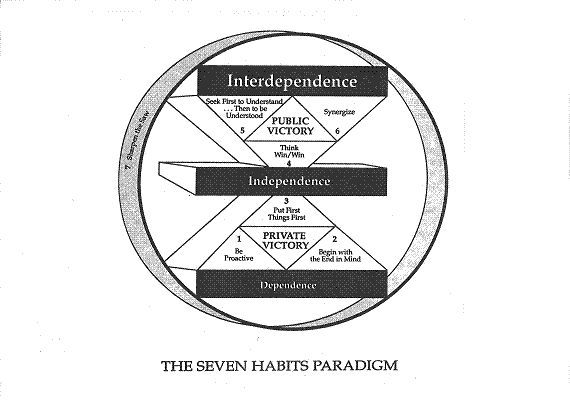
Reading the overview of the seven habits, I laughed when I saw that the seventh habit was effectively that of renewal. It gave me some confidence that I've vaguely got the right idea in establishing a new blog as a tool to reorientate myself in relation to my thesis and life in general.
***
The most important thing to say about The 7 Habits that I've read so far, is that it's confounding my expectations. I'd imagined it would give advice such as 'be more assertive' or 'work on your communication skills' etc. Not at all. In fact, it makes a very useful distinction between the Personality Ethic and the Character Ethic.
The author, Stephen R. Covey, reviewed the self-help literature of the past 200 years or so and noted that the first 150 years of advice was characterised by the Character Ethic, while the most recent 50 years has been dominated by the Personality Ethic. It turns out that it's been the Personality Ethic that I've had difficulty with ever since my mother did courses at the Positive Living Centre after her divorce from my father and constantly admonished me to 'stop thinking negatively'.
The Personality Ethic essentially consists of two approaches: 'human and public relations techniques' and assuming a 'positive mental attitude'. Covey writes that 'parts of the personality approach were clearly manipulative, even deceptive, encouraging people to use techniques to get other people to like them...'. In contrast, the Character Ethic is about integrating certain principles and habits into your basic character. Thinking about the Character Ethic, I think it appeals to me because it's something I can build on, principles that I can refer to in a range of circumstances.
In the first instance building character seems to be about identifying where you are on the Maturity Continuum: dependence--independence--interdependence. Ostensibly, I'm independent, but--and only I can say this--I lack maturity, because I am incredibly dependent on other people's good opinion of me, to the extent that it's really quite debilitating. I often feel disheartened and usually resentful if my efforts aren't appreciated. I need someone to acknowledge that I've done a good job or I can't grasp that I may have done a good job. Of course we all need some acknowledgment, but not to the extent that you can't live without a constant supply.
Right now, I'm in the process of working on an aspect of another model that Covey offers, the Production-Production Capability. He uses Aesop's fable of the Golden Goose to suggest that we must pay attention to the asset that enables production in order to be effective. Not to be too dramatic, but I do feel a bit like a slaughtered goose at the moment.
On a side note, I think this is what Universities most neglect in their treatment of sessional academics; they fail to look after the goose in pursuit of the golden eggs of filling temporary tutoring and lecturing positions. Unfortunately that's where the allegory goes a little awry, because it does seem that sessional staff are in constant supply. Still there is a growing pile of fetid, putrifying geese and that's got to get someone's attention soon.


No comments:
Post a Comment